Oklahoma Turnpike Authority targeted again for potential reform
5 min read
Oklahoma Legislature
The Oklahoma Turnpike Authority continues to face scrutiny amid an ongoing bond-financed expansion program and calls to reform the toll road agency.
The 15-year ACCESS Oklahoma (Advancing and Connecting Communities and Economies Safely Statewide) program, which was officially launched by Gov. Kevin Stitt in February 2022, aims to widen existing toll roads and build new ones at
About $1.61 billion of revenue bonds have been sold so far for the program, which has been targeted by unsuccessful litigation brought by property owners in the path of new toll roads, while legislation in recent years that
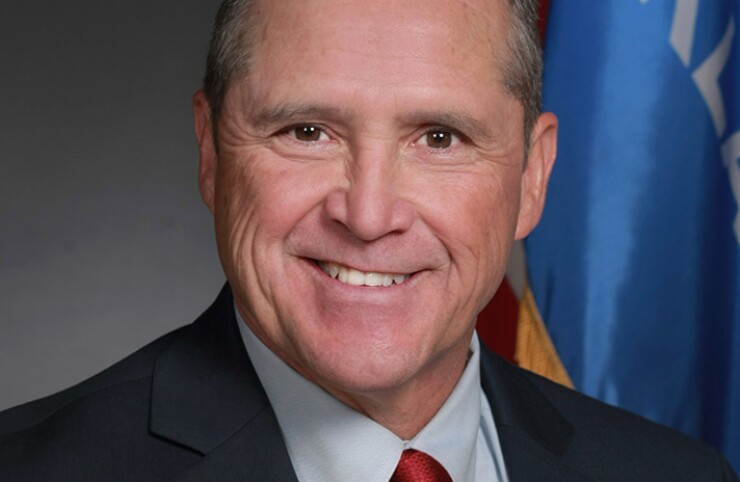
Republican State Rep. Danny Sterling, who has introduced several reform bills, said transparency was a focus of the latest in-depth examination of OTA by lawmakers last month, pointing to the potential for greater legislative oversight.
“We also know that the OTA has been given much latitude legislatively in the past and it might be time for us as legislators to revisit that, to make sure we haven’t gone too far in one direction again,” he said as a so-called interim study commenced on Nov. 6.
OTA Executive Director Joe Echelle told lawmakers turnpikes are a cost-effective way to build highways.
“We’re user-fee-funded, which has helped us in Oklahoma as a state maintain very low motor fuel taxes throughout our history, because we’ve been able to leverage a user-fee-funded system in the turnpike,” he said.
Officials with Oklahomans for Responsible Transportation, which is battling against the ACCESS program, raised concerns about OTA’s eminent domain and bond practices, as well as its finances.
Amy Cerato, the group’s president, told The Bond Buyer reforms will be sought in the Republican-controlled legislature next year, including imposing a debt ceiling and ending OTA’s ability to pool revenue from the entire system to back bonds.
“If the super-majority committee chairs would get out of our way and let our bills be heard, our bills would pass almost unanimously through both houses,” she said in an email. “They are common sense, citizen-protective bills, but the committee chairs are a huge problem.”
The group also wants to see an
In March 2023, Oklahoma Republican Attorney General Gentner Drummond cited financial and contracting concerns when he ordered the State Auditor and Inspector’s Office to produce the audit, which has yet to surface.
OTA, which operates 12 turnpikes totaling 630 centerline miles, sold an initial
Another round of bond financing is likely by the end of 2026, according to an OTA spokeswoman.
The legislature’s interim study also covered an October
“The first (is) that the turnpike system has become the state’s primary method for constructing new major roadways,” she said. “And then second, while changing Oklahoma’s turnpike model is possible, it would take decades to fully realize.”
The report examined the possibility of ending tolls, noting a $3 billion payoff for existing OTA bonds.
“If the legislature sought to immediately make the state’s turnpikes toll-free, it would have to satisfy this bond debt plus absorb the annual $260 million in asset preservation and maintenance costs for the roads,” the report said, adding OTA expects to issue another $6.6 billion of bonds over the next 13 years.
Other alternatives were to cap OTA’s bond indebtedness at $8.2 billion, allow OTA to continue to collect tolls once all bonds are retired to cover maintenance costs, or allow the periodic transfer of turnpikes to ODOT until all are toll free. The latter option “would require issuing new bonds with payoff triggers and enforcing a moratorium on new turnpike projects,” according to the report.
It also recommended lawmakers determine whether authorized but unbuilt turnpike routes “still match state priorities,” while adding sunset provisions for newly approved turnpikes.
An
“Oklahoma has a great story to share about its sustainable, user-fee-based approach to construct and maintain turnpike infrastructure that supports and connects seamlessly with the tax-funded state highway system,” it said.
The agency, however, continues to face litigation.
Oral arguments were held last month in
“On March 13, 2025, the additional access point and interchange with State Highway 20 on the Will Rogers Turnpike at Flint Road opened to public use with no free four-lane road parallel to the turnpike, no lease of the turnpike with concomitant elimination of tolls, and no compliance with Section 2004(А),” the lawsuit stated.
The two transportation agencies responded in August with a motion to dismiss the lawsuit, contending OTA’s tolling authority is lawful and that the section of law cited would impair contracts with OTA’s bondholders.
OTA is also seeking to dismiss
A
The law took effect Nov. 1, 2023, after the
Oral arguments in
Stitt prevailed in a dispute with Drummond, who
The State Supreme Court on Nov. 12