University of California returns to market with a bigger deal
6 min read
Bloomberg
The Regents of the University of California return to the municipal bond market next week with an offering upsized from the one pulled in August amid Trump administration threats to its research grants.
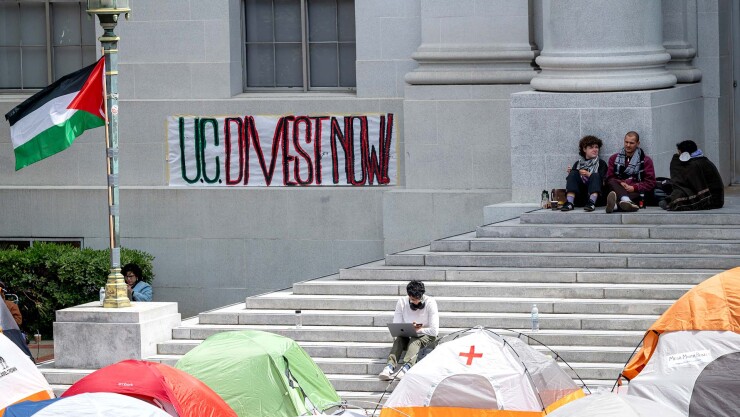
The university had planned to price $1.5 billion in revenue bonds on Aug. 19 but was hit with a series of letters from the Trump administration in late July and early August threatening more than half a billion dollars in grant funding.
Now it plans a $2 billion Series CD general revenue bond sale for Dec. 9.
The university declined to comment in August on its reasoning for pulling the deal and failed to respond to a request for comment this week on the rescheduled deal.
Jefferies and BofA Securities will lead a 24-bank syndicate in pricing the debt. PFM is the municipal advisor, Orrick Herrington & Sutcliffe is bond counsel and disclosure counsel and O’Melveny & Myers LLP is underwriters counsel.
The bond proceeds will pay for campus and medical center projects and for the cost of issuance, according to the preliminary offering documents.
A broker-dealer, who asked to not be named,
The battles with the Trump administration over the grant funding
“We don’t think the credit is on the verge of a downgrade, but if your story highlights that there are concerns and there was a delay, I think fewer people will buy the bonds, because there is a cloud hanging over it,” Brothers said.
The deal carries ratings of Aa2 from Moody’s Ratings, AA from S&P Global Ratings and AA from Fitch Ratings.
Bel Air had not planned to purchase the UC debt because it already holds existing debt from the university and it’s currently looking at credits not as commonly issued, and UC Regents typically come to market two or three times a year, he said.
“We like revenue bonds, but there is headline risk here,” Brothers said. “We would be more comfortable purchasing UC Regents than the state, state public works or Los Angeles Unified School District. But we are finding higher-rated school district general obligation bonds — and they aren’t coming to market two or three times a year.”
Trump had targeted
The administration also threatened university research grants of universities on the east coast and in California citing failure to abandon diversity programs that support non-whites and other disadvantaged groups in the admission process and policies that allow transgender athletes to compete according to their gender identity.
“The university is not aware of the federal government initiating litigation against the university on or after its stated Sept. 2, 2025, deadline,” the POS says, adding that the university has prevailed in two lawsuits ordering the grant funding be restored.
The UC Regents were notified at the end of July and beginning of August through a series of letters from the federal government that it was suspending more than 800 grant awards to the University of California-Los Angeles, placing at risk roughly $584 million in funding over the remaining life of those grants, according to the POS.
It followed up on Aug. 8 with a demand for a $1 billion settlement to restore the grants, but did not specify which or how many grants would be restored, according to the POS. The Department of Justice’s proposed resolution, also asked for a $172 million payment into a claims fund stemming from DOJ and U.S. Equal Employment Opportunity Commission investigations.
The university has not agreed to the resolution, according to the POS, but it did offer to engage in a dialogue with the Trump administration.
The university cannot predict how long the federal actions will continue and if they could materially impact its financial conditions or operations, the POS adds.
The University of California, the nation’s largest public university system, has nine general campuses, a health science campus in San Francisco, six academic medical centers and the Lawrence Berkeley National Laboratory. It provided instruction to roughly 293,000 full-time undergraduate and graduate students for the year ended June 30, 2024, according to an investor presentation.
UC Regents derived $60.68 billion in revenues from its medical centers, grants and contracts, student tuitions and fees, educational activities, state educational appropriations and private donations. It received $4.9 billion in state funding in fiscal year 2025-26, but $129.7 million of that was deferred to fiscal year 2026-27.
It received nearly $8.7 billion in federal, state and local government grants in fiscal year 2024-25, according to its investor presentation.
“UC benefits from having a relatively diverse revenue base,” said Emily Wadhwani, senior director of U.S. Public Finance for Fitch Ratings. “They have healthy and strong enrollment that tends to outperform the rest of the market.”

Fitch Ratings
The funding threats didn’t affect the ratings; the three agencies issued revised reports ahead of next week’s deal affirming the bond ratings they originally assigned in August. All assigned stable outlooks.
“This is a redux of what they proposed in August,” Wadhwani said. “It’s not a new transaction for them.”
UC had the authorization to issue up to $2 billion originally, Wadhwani said, so the deal coming now reflects the Regents, under the guidance of their bankers, “hitting the market with this version of the transaction.”
The transaction doesn’t reflect a significant change in the university system’s long-term capital plans; and the proportion of the $27 billion, five-year capital plan being funded by debt hasn’t changed, she said.
“Our rating incorporates future debt assumptions as well as the current one,” Wadhwani said. “That’s why we haven’t changed anything based on this plan of finance.”
She suspects the timing change enabled the university system to roll in other projects that were approved and ready for bond financing. “I don’t think the risk to federal funding was a factor [in the upsized deal],” Wadhwani said. “It was more to incorporate additional projects they would need to bond for in future issuances.”
Fitch rating has had the higher education sector on negative outlook for several years and expects to release its 2026 outlook for the sector any day now, she said.
“The headwinds remain challenging,” Wadhwani said. “I wouldn’t anticipate a change in the outlook.”
The number of high school graduates is declining in most markets and the country is in a challenging landscape for attracting international students given immigration enforcement, she said.
Despite that, 80% of the universities Fitch rates have a stable outlook. Its sector outlook takes the entire universe of public universities into account, including smaller unrated colleges.
S&P analysts wrote Dec. 2 report that the stable outlook assigned “reflects our expectation that the system will maintain its already impressive enterprise risk profile and maintain financial resources relative to operations and debt in line with rating medians.”
If significant costs are incurred to research funding from evolving federal policies and operational finances are materially weakened, it could result in a negative rating action, S&P wrote.
Bel Air’s Brothers questioned why UC Regents bankers are bringing an upsized deal in mid-December when demand typically picks up in January, as institutional investors look to reinvest debt that has matured and individual investors seek to park bonuses in bonds.
The market usually starts to peter out after Thanksgiving, so by January demand for bonds is frenetic, he said.
With a strong likelihood the Federal Reserve will cut rates next week and the employment reports for October and November will be dismal, Brothers expects if the UC Regents had waited until January, it wouldn’t be a situation
where they say in January, “It’s a good thing we got this deal done.”
He added that Bel Air is going after deals aggressively this week before supply peters out.